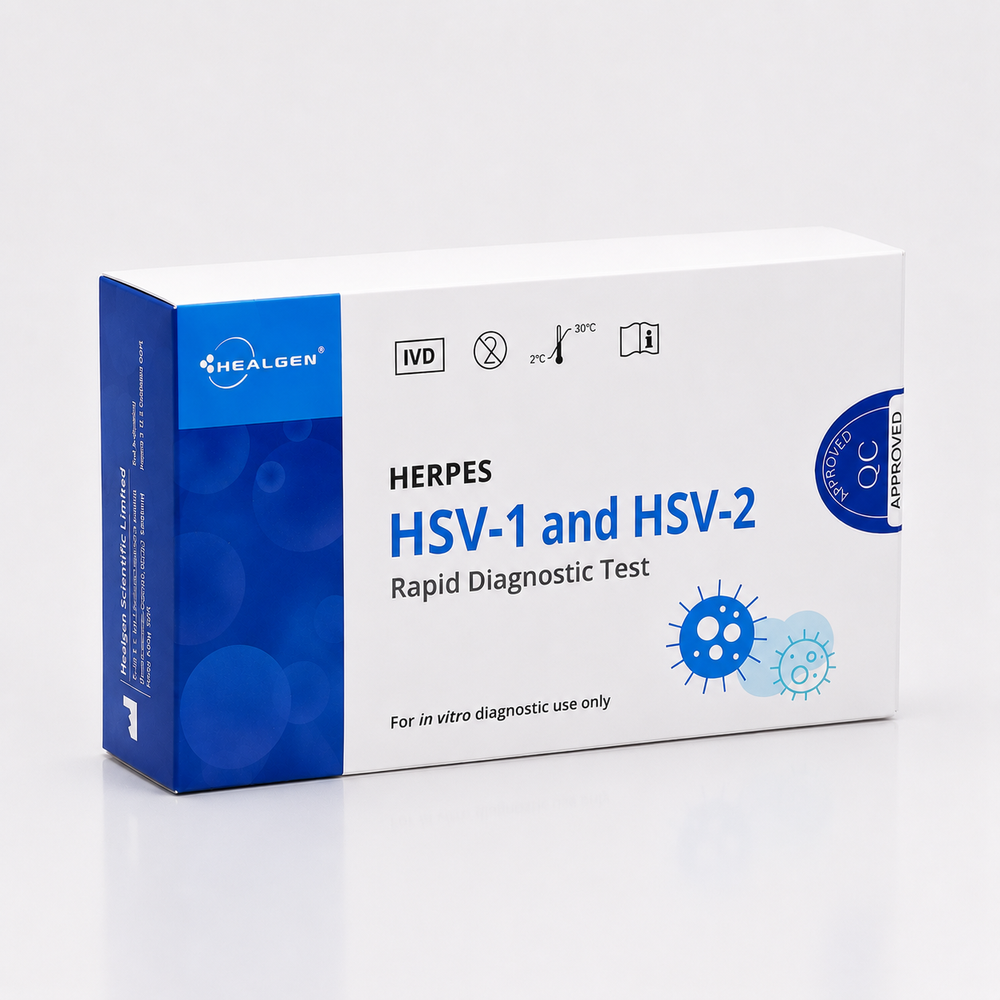
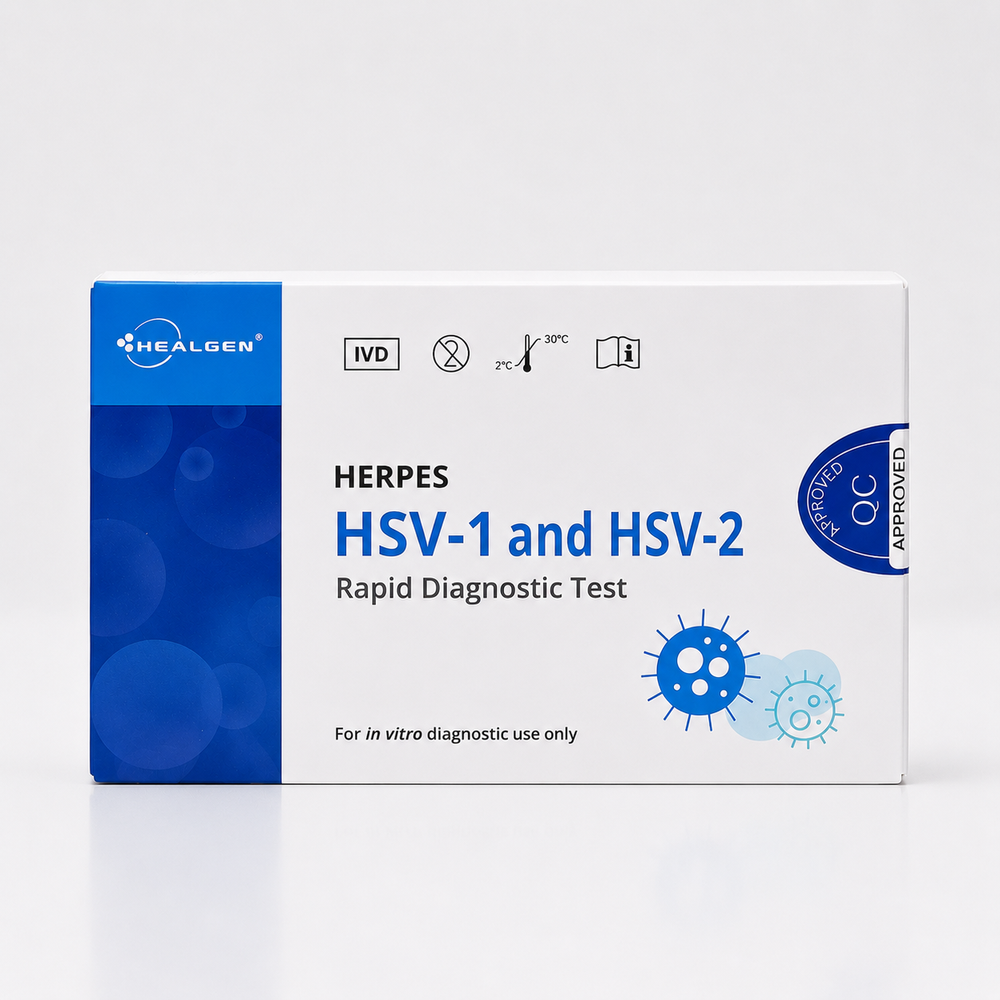
Herpes HSV-1 and HSV-2 Test
Quick Facts Up to 98% accuracy (manufacturer's stated figure) Ships same day before 2 PM Discreet letterbox delivery Tests for both HSV-1 and HSV-2
OverviewWhat this test is
The Combined HSV-1 & HSV-2 Home Rapid Test looks for antibodies to both herpes simplex virus type 1 and type 2 in a single kit. HSV-1 is most often linked to oral cold sores and HSV-2 to genital infections, though either type can affect either area. It is used at home and read using the reading key provided.
Screening tests are a starting point, not a final answer. Any reactive result should be confirmed by a clinician, and a non-reactive result does not fully rule out infection.
FeaturesDesigned to be simple
Two results, one test
Reads HSV-1 and HSV-2 antibodies separately in a single kit.
Read it yourself
A clear control/test line key lets you interpret your own result at home.
Discreet by default
Plain packaging with no product name on the outside.
Result in minutes
Follow the wait time in your kit's instructions.
In the boxWhat's included
Confirm exact kit contents against the supplied IFU before publishing.
SuitabilityWho this is (and isn't) for
May be suitable if you
- Want a private screening check without a clinic visit.
- Are past the window period recommended in the instructions.
- Are able to follow the steps and read the result key.
Do not rely on this test alone if you
- Have symptoms or a recent known exposure — seek clinical care.
- Are pregnant or under 18 (confirm age policy per IFU).
- Need a definitive diagnosis — that requires laboratory testing.
AccuracyWhat the figures mean
We publish the manufacturer's figures for each analyte exactly as they appear in the instructions for use. No screening test is 100% accurate.
InstructionsStep by step
Always follow the printed instructions supplied with your kit, which take priority.
Clean the fingertip
Use the alcohol wipe and let it dry.
Collect the sample
Use the lancet, then draw blood into the pipette to the marked level.
Apply & add buffer
Add the sample to the well, then the stated buffer drops. Drop count per IFU.
Wait & read
Start a timer for the stated wait time, then read within the stated window. Timing per IFU.
Reading resultsInterpreting the window
This combined kit shows three markers: a control line (C), an HSV-1 test line (1), and an HSV-2 test line (2). Each test line is read on its own, so you may see one, both, or neither. The control line must always be present for a result to be valid. Confirm the marker layout against the IFU.
Non-reactive
Control line only (C).
HSV-1 reactive
Control + line 1.
HSV-2 reactive
Control + line 2.
Invalid
No control line.
If both test lines appear alongside the control, antibodies to both types may be present. Any reactive result should be confirmed by a healthcare professional.
ImportantSafety & care
- For in-vitro diagnostic home use only. Do not swallow any component.
- Single use only — do not reuse the cassette or lancet.
- Keep out of reach of children. Do not use if the pouch is damaged or expired.
- This test is specific to HSV-1 and HSV-2 antibodies and does not detect all infections.
- A result from this test is not a diagnosis. Confirm any reactive result with a healthcare professional.
DeliveryShipping & returns
Shipping
- Dispatched from the UK in plain packaging.
- Delivery timeframe: to be confirmed.
- Shipping cost shown at checkout.
Returns
- Your statutory rights under UK consumer law apply.
- Special rules apply to opened sealed medical items (pending legal review).
- Contact support to start a return.
FAQProduct questions
Does a reactive result mean I definitely have herpes?
No. A reactive line for either type means antibodies may have been detected; confirm with a clinician through laboratory testing. This kit reports HSV-1 and HSV-2 separately.
What if both test lines appear?
Antibodies to both types may be present. Any reactive result should be confirmed by a healthcare professional.
Is my order discreet?
Yes — plain, unbranded packaging with a neutral sender name.
How is this different from the single-type kits?
This kit checks both HSV-1 and HSV-2 in one test; the single kits check one type each.